
Charles Atlas

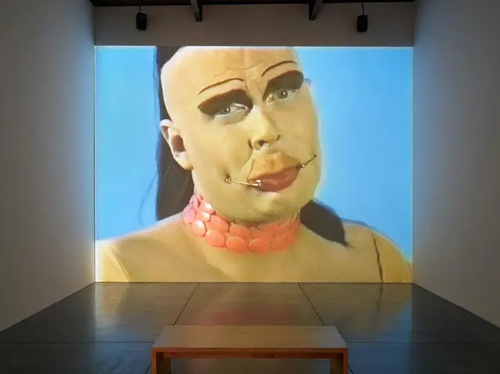
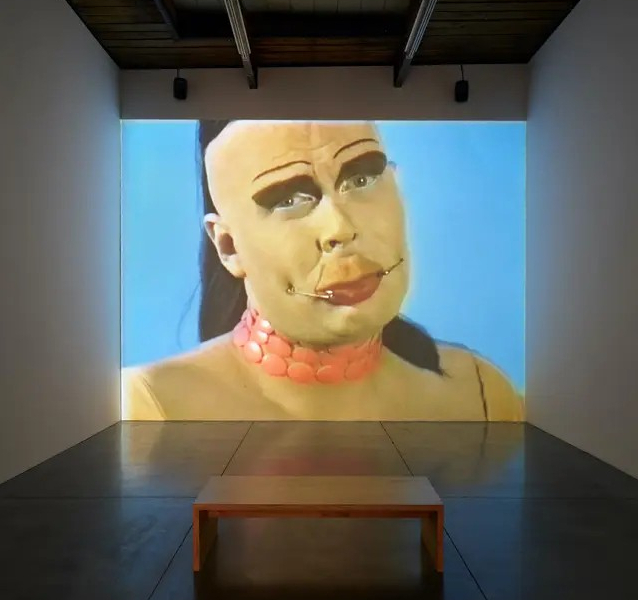
Installation view: Yasumasa Morimura and Charles Atlas: Anamneses, Luhring Augustine, New York, 2026. © the artists. Courtesy the artists and Luhring Augustine, New York. Photo: Farzad Owrang.
Here’s the thing about spectatorship: at the end of the day, it’s about power. More acutely, it’s a display of authority. In the charged dynamic between seeing and being seen—between who controls the look and who is reduced to spectacle—viewers have historically held the power. And what of spectatorship’s parasitical twin, voyeurism? What are the stakes when bodies are on display? For artists Yasumasa Morimura and Charles Atlas, that’s the question, and a joint exhibition featuring works by both artists answers it unambiguously: our freedom.
Morimura is perhaps best known for his photographic tableaux restaging paintings from the Western art historical canon, with himself cast in the leading role. Among works included in the current show, Une Moderne Olympia 2018 (2018) is a riff on Édouard Manet and Paul Cézanne’s works of a similar composition and name—Morimura plays the part of the reclining nude. Daughter of Art History (Princess A) (1990) channels Diego Velázquez’s Infanta Margarita Theresa in a White and Silver Dress (1656)—a child-size Morimura deadpanning in full courtly attire. Great lengths are taken by Morimura to recreate not only a painting’s respective mise-en-scène (period costumes, elaborate props, theatrical sets) but also the style of its painter (brushstroke, texture, palette) with Morimura going so far as to paint his own body and clothes in the same manner. Attentive viewers will observe Morimura doing his best impression of Cézanne’s quick, directional hand. Adding to the theatricality of it all, Morimura applies a glossy varnish mimicking brushstrokes to the surface of his photographic prints.
---
Atlas, like Morimura, prominently features queer bodies in his ongoing body of work; the queer body, after all, has long been the subject of regulation, pathology, and fetish. Both artists refuse the passivity expected of the spectacle, claiming agency for the viewed over the voyeuristic viewer. Yet, whereas Morimura’s photographs preserve the relationship between observer and observed—Morimura occupying the latter position to subvert it from within—Atlas’s films fragment the unifying spectatorial gaze into multiple, partial perspectives. To achieve this, Atlas combines formal techniques—non-linear editing, rapid-fire intercuts, archival self-sampling—with storylines featuring queer artists and personas of the 1980s and ’90s.
Read full article at brooklynrail.org

