
Zarina

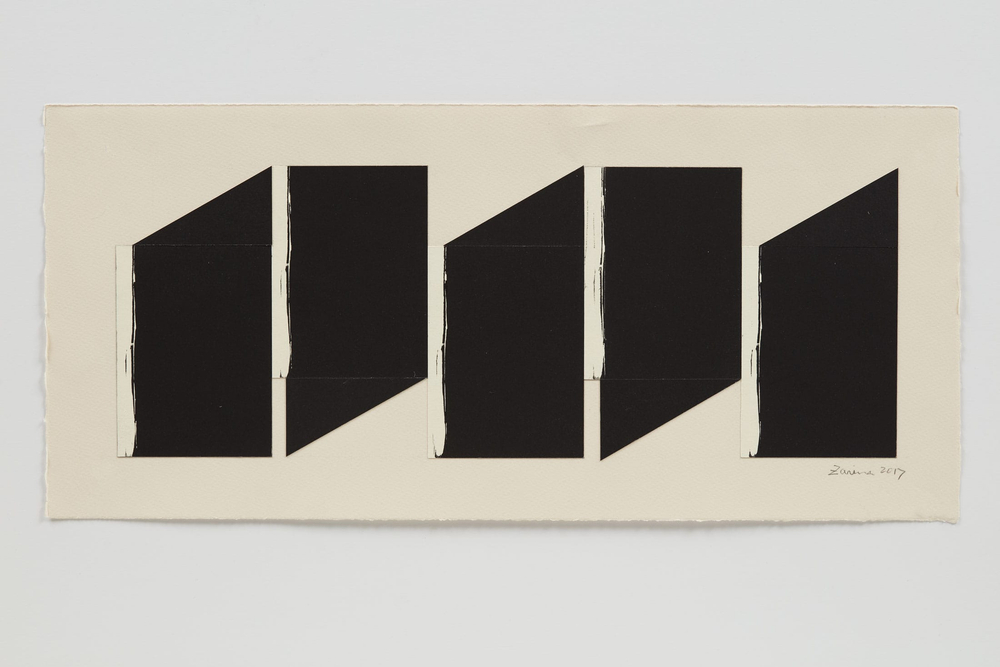
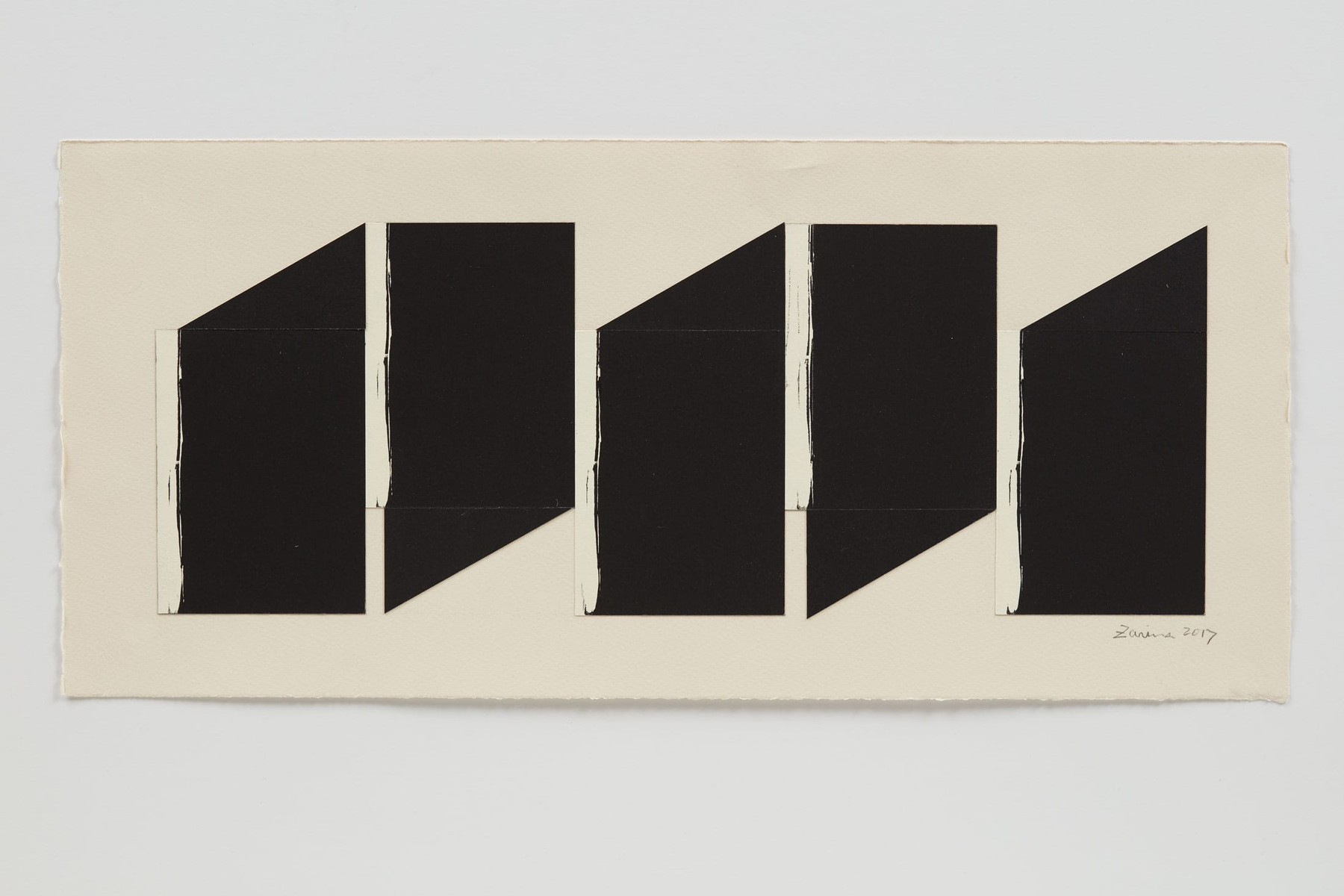
Zarina, “Untitled” (2017), collage with woodcuts printed on BFK light paper mounted on Arches Cover buff paper (photo Farzad Owrang, courtesy Luhring Augustine Gallery)
Zarina Hashmi, known professionally as Zarina, lived a peripatetic life. She was born in 1937 in Aligarh before Indian Partition, moved temporarily with her Muslim family to Pakistan in the wake of that traumatic upheaval, and subsequently lived, studied, and worked in Bangkok, New Delhi, Paris, Tokyo, and many other places besides, before her death in 2020. Her oeuvre — spare, post-minimalist prints, drawings, cast-paper reliefs, and sculptures — consistently returns to questions of mapping place, remembering home, and understanding migration. It is indelibly marked by her nomadism — sometimes chosen, sometimes forced.
But Zarina was at the same time very much a New York artist. She arrived in the city in 1976, and quickly became embedded in some of the most consequential art scenes of the era — she was a member of the New York Feminist Art Institute; on the editorial board of Heresies magazine, where she co-edited the landmark Third World Women issue in 1979; and she co-curated the crucial exhibition Dialectics of Isolation: An Exhibition of Third World Women Artists in the United States with Kazuko Miyamoto and Ana Mendieta at A.I.R. Gallery in 1980. The Museum of Modern Art acquired her work as early as 1974, she was the subject of a retrospective at the Guggenheim Museum in 2013, and has shown multiple times at Luhring Augustine Gallery, including her current exhibition, Beyond the Stars.
Zarina’s work is all about dislocation — she once called “home” an “idea we carry with us wherever we go” — so it might seem perverse to emphasize her locatedness in New York. But it was precisely her presence in the city that made Zarina so important to many South Asian American artists and art workers of subsequent generations, especially women. She was one of the few who were visible despite the precarity of life as a woman of color, which in her case included eviction attempts and sidelining by White feminists of her generation. She was a bulwark against a doggedly persistent erasure. (It shocks me every time I’m confronted by yet another artist list for the Whitney Biennial with no or almost no South Asian American artists; since the exhibition was established in 1930, only 10 or so artists of South Asian descent have been shown in the galleries.) Even as other diasporas have — after much effort, activism, and talent — been recognized as having a place within the broader definition of what constitutes “American art,” South Asian American artists are generally marked as outside the fold, their culture largely understood solely through the lens of Big Fat Weddings and Bollywood.
Read full article at hyperallergic.com
